Charts — 89 charts across futures, options and macro
Futures — one asset or the whole market at once — options and macro in one module. Charts ship with a plain-English READING that tells you what the data is saying right now — not just what it shows.
Charts walkthrough — recorded when the module had 67 chartsCharts — futures, options and macro on one tab
Why it exists
Most traders read charts across three or four different services — one for futures price and open interest, another for the options surface, another for macro context — and none of them tell you what the data actually means. You're left to interpret raw lines yourself, on every chart, every time.
FOCSAL Charts puts 89 charts in one module and adds a READING to them: plain English on what the chart is saying at this moment. Funding overheated? The footer tells you. CVD diverging? The footer tells you. Yield curve inverting? The footer tells you.
What you get
89
Charts, three markets
Futures — one asset or the whole market at once — options and macro, in one module, no platform switching.
READING
Plain-English footer
Every chart explains what it's saying right now — the same logic that feeds Market Intelligence and the AI Analyst.
5s
Live streaming
All 153 assets — crypto and real-world — with the most liquid ones refreshed fastest.
Sync
Zoom across charts
Zoom or pan one chart and the rest follow. Save any cross-market combination to Favorites as one view.
The full chart catalogue
Below is every chart, grouped the way the platform organises them. If you've searched for a specific indicator, it's almost certainly here.
Futures · 19 charts
One asset at a time, on all 153 assets. Real-world assets have no spot market, so 16 of the 19 charts apply to them — Basis / Premium vs Price, Spot vs Perps Volume and CVD Spot vs Perps need a spot price.
Price & Volume · 4
Chart
What it shows
Price
Perpetual contract price over time.
Perps Volume
Trading volume on the perpetual contract per bar.
Spot vs Perps Volume
Spot volume next to perpetual volume.
Delta Volume
Aggressive buy volume minus aggressive sell volume on perps.
Open Interest · 5
Chart
What it shows
Open Interest
Open perpetual contracts, in units of the asset.
OI vs Price
Open interest plotted alongside price.
OI Delta
Change in open interest per bar.
OI Regime
Each period classified by the sign of its price change and its OI change.
Long/Short Ratio + OI
Long/short account ratio alongside open interest.
Funding & Basis · 3
Chart
What it shows
Funding vs Price
Funding rate per settlement period, alongside price.
Basis / Premium vs Price
Perp price minus spot price as a share of spot, alongside price.
Long/Short Ratio (LSR)
Accounts positioned long versus accounts positioned short.
Order Flow · 3
Chart
What it shows
CVD Spot vs Perps
Running total of taker buying minus selling, on spot and on perps.
Cohorts spot / perp
Aggressor buying minus selling split by order size, from under $10k to over $1M.
Taker Ratio
Aggressive buy volume divided by aggressive sell volume, with its smoothed average.
Liquidations · 4
Chart
What it shows
Liquidations Split
Long and short liquidations side by side.
Liquidations Over Time
USD value of positions force-closed for insufficient margin.
Liquidations Bubbles
Individual liquidation events sized by USD value, over price.
Liquidations Cumulative
Running total of liquidations.
Market · 13 charts
The 96 crypto perpetuals as one cross-section: what moves, who is positioned, what leads and how the market moves as a whole.
Overview · 3
Chart
What it shows
Market Scanner
Every perp in one table — moves, strength vs BTC, OI change, funding, flow, liquidations — with signal chips.
Move Heatmap
Every perp across 1h, 4h, 24h, 7d and 30d: what moved and how unusual the move was.
Hourly Heatmap 48h
Every perp across the last 48 closed hours, in sigmas of its own volatility.
Positioning · 3
Chart
What it shows
Positioning Map
Every perp as a point: price change against OI change, coloured by funding or flow, sized by OI.
Spot vs Perp Flow
Net taker aggression on spot against perp for every asset.
Funding Map
Funding of every perp on one grid, assets by time, as % per year.
Strength & rotation · 3
Chart
What it shows
Relative Strength
Which assets outperform BTC over 1, 7, 30 and 90 days, and their relative-strength state.
RS Lines vs BTC
Price of perps divided by BTC, indexed to 100 at the start of the window.
Rotation Graph (RRG)
Each perp's rotation vs BTC: relative-strength trend against its momentum, with a tail.
Market structure · 4
Chart
What it shows
Correlations & Clusters
How the top perps move together, with sector clusters found after removing BTC.
Market Dispersion
Spread of daily returns across perps over a year, with the regime it implies.
Market Breadth
Share of perps above their 20-, 50- and 200-day average, with the altcoin season index.
Advance / Decline
Daily count of perps closing up versus down, the cumulative A/D line and the McClellan oscillator.
One row per asset with options: ATM IV, skew, put/call OI, net gamma and the implied move.
Expiry Structure · 4
Chart
What it shows
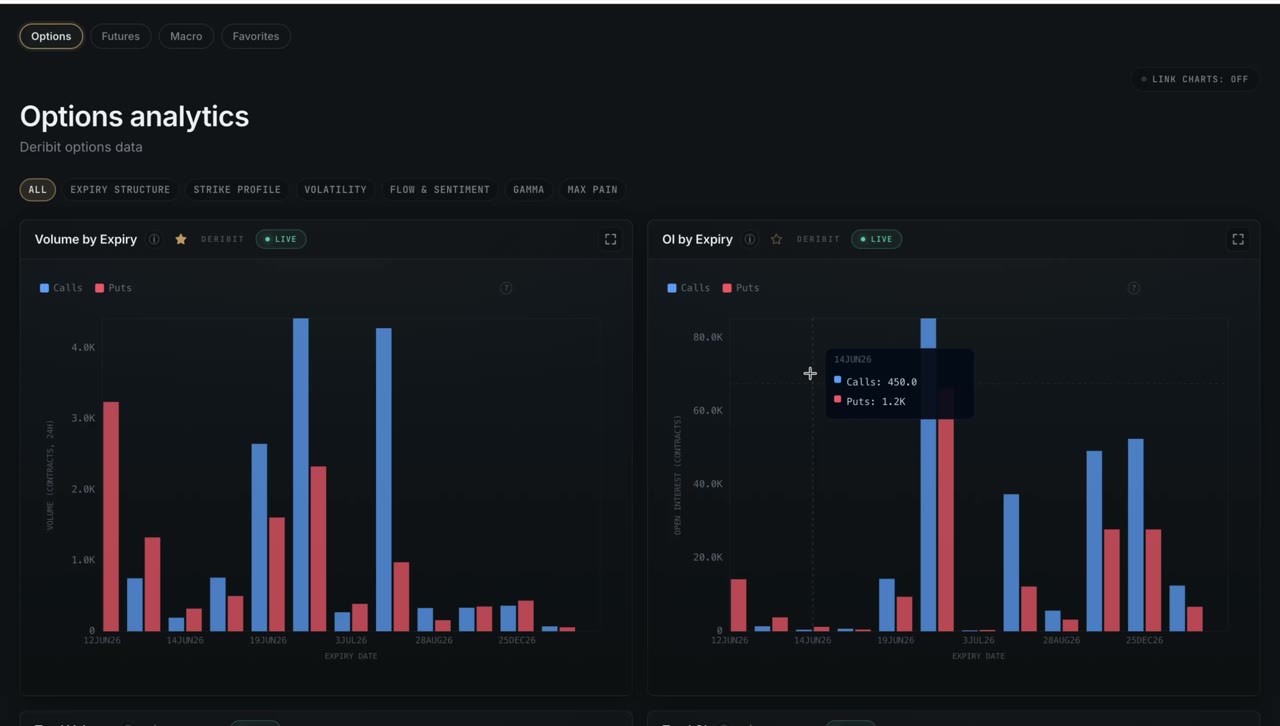
Volume by Expiry
Daily options volume grouped by expiry.
OI by Expiry
Open interest spread across expiries.
Total Options Volume
Rolling 24-hour volume of all options, calls and puts.
Total Open Interest
Total open options positions, calls and puts, summed over every live expiry.
Strike Profile · 3
Chart
What it shows
Volume by Strike
Volume grouped by strike for the selected expiry.
OI by Strike
Open positions at each strike for the selected expiry.
Gamma by Strike
Gamma exposure per strike in USD per 1% move, unsigned.
Volatility · 13
Chart
What it shows
Implied Volatility (ATM)
At-the-money implied volatility at a constant 7-, 30- or 90-day maturity.
25Δ Skew
25-delta put IV minus 25-delta call IV at a constant maturity.
25Δ Skew by Tenor
25Δ skew at 7, 30 and 90 days, one line per tenor.
Multi Expiry Skew
The skew curve — IV against strike — for several expiries on one chart.
Term Structure — Implied vs Forward IV
ATM IV per tenor and the forward IV implied between tenors.
IV Term Structure (Multi-Skew)
ATM IV and the 10Δ / 25Δ / 35Δ skew for every expiry.
IV vs RV + Spread
Implied volatility at 30 days against volatility realised over the last 20 days.
Gamma Exposure (unsigned)
Gamma of the whole chain with no sign, in USD per 1% move.
Net GEX (signed)
Net gamma exposure of the whole chain over time, calls counted plus and puts minus.
25Δ Butterfly per Tenor
25Δ butterfly — average wing IV minus ATM IV — at constant maturities from 1W to 1Y.
Probability of Expiring Above Strike
Risk-neutral probability that price finishes above each strike at expiry.
Expected Move to Settlement
How far price may move by the next settlement, as priced by implied volatility.
Volatility Risk Premium
Implied volatility against the volatility realised over the next 30 days, with the volatility cone.
Flow & Sentiment · 5
Chart
What it shows
Buy/Sell Volume
Volume split into aggressive buying and selling, for calls and puts.
Buy/Sell by Expiry
Aggressor flow over time for the selected expiry.
OI Change
Change in open interest for calls and for puts.
OI Change Map
Change in open interest per strike and expiry over the last 1, 4 or 24 hours.
OI Distribution (ITM/OTM × C/P)
How open interest splits across in- and out-of-the-money calls and puts.
Gamma · 2
Chart
What it shows
Gamma by Strike (Signed)
Gamma exposure per strike, calls counted plus and puts minus, with the level where the sum changes sign.
Top Gamma Levels
The five strikes with the largest positive and the five with the largest negative gamma exposure.
Max Pain · 1
Chart
What it shows
Max Pain vs Price
The strike at which option holders' total payoff at expiry would be smallest.
Execution cost · 1
Chart
What it shows
Execution Cost Map
What a round trip costs right now — spread plus fees — as % of the option's mid price.
Macro · 27 series
Net Liquidity · 6
Chart
What it shows
Fed Balance Sheet (WALCL)
Total assets on the Federal Reserve's balance sheet.
Reserve Balances
Bank reserves held at the Federal Reserve.
Reverse Repo (RRP)
Cash parked at the Fed overnight by money market funds and dealers.
Treasury General Account (TGA)
The U.S. Treasury's cash account at the Fed.
SOFR Volume
Daily volume in the secured overnight financing (repo) market.
M2 Money Supply
Broad money supply: currency, deposits and near-money.
Rates & Yields · 5
Chart
What it shows
SOFR Rate
Benchmark rate for overnight lending secured by Treasuries.
Fed Funds Rate
The Federal Reserve's policy rate.
10-Year Treasury Yield
Yield on the 10-year U.S. Treasury.
2-Year Treasury Yield
Yield on the 2-year U.S. Treasury.
10Y-2Y Yield Curve (T10Y2Y)
10-year minus 2-year Treasury yield.
Credit Spreads · 2
Chart
What it shows
High Yield Credit Spread
Spread of high-yield corporate bonds over Treasuries.
Investment Grade Credit Spread
Spread of investment-grade corporate bonds over Treasuries.
Inflation · 4
Chart
What it shows
CPI (Consumer Price Index)
Headline consumer price index.
PPI (Producer Price Index)
Producer price index — input costs faced by producers.
5-Year Breakeven Inflation
Market-implied inflation over the next 5 years.
10-Year Breakeven Inflation
Market-implied inflation over the next 10 years.
Labor Market · 3
Chart
What it shows
Unemployment Rate
U.S. unemployment rate, monthly.
Initial Jobless Claims
Weekly count of new unemployment insurance claims.
Non-Farm Payrolls
Monthly change in U.S. non-farm employment.
Dollar & FX · 3
Chart
What it shows
DXY (Dollar Index)
U.S. dollar against a basket of major currencies.
EUR/USD
Euro against the U.S. dollar.
USD/JPY
U.S. dollar against the Japanese yen.
Markets · 4
Chart
What it shows
S&P 500
Benchmark U.S. equity index.
VIX (Volatility Index)
Implied 30-day volatility of S&P 500 options.
Bitcoin
Bitcoin price in USD.
U.S. GDP
U.S. gross domestic product, quarterly.
How it works
Every chart reads from one streaming layer — the same data that powers the rest of the platform — so nothing is computed on the fly and nothing drifts between modules. The most liquid assets update fastest.
The READING footer under each chart is generated by the same rule engine that feeds Market Intelligence and the AI Analyst. That means the interpretation you read on a chart is the exact signal the rest of the system acts on — one source of truth, no contradictions.
Part of the operating system
Charts is the research and monitoring layer. When a footer flags something worth acting on — a CVD divergence, a short-gamma regime, an inverting curve — you move into the deep-dive modules: Order Flow for tick-level detail, Options Map for the full gamma surface, Market Intelligence for the combined verdict. Same data underneath, no switching tools.
What charts does FOCSAL include for crypto futures?
Nineteen charts for a single asset across five categories — Price & Volume, Open Interest, Funding & Basis, Order Flow and Liquidations — and thirteen Market charts that read all 96 crypto perpetuals at once: a scanner, heatmaps, positioning and funding maps, relative strength, correlations and breadth.
What options charts are available?
Thirty options charts for BTC, ETH, SOL, XRP, AVAX and HYPE: a cross-asset scanner, expiry structure, strike profile, thirteen volatility charts (IV, 25-delta skew, term structure, IV/RV, gamma exposure, butterfly, probability above strike, expected move, volatility risk premium), flow & sentiment, signed gamma by strike, max pain and an execution cost map.
Does FOCSAL show macro charts like the Fed balance sheet and yield curve?
Yes — 27 macro series across Net Liquidity (Fed balance sheet, reserves, reverse repo, TGA, M2), rates and yields, credit spreads, inflation, labor, dollar/FX and markets including the S&P 500 and VIX.
What is a CVD divergence chart?
It compares cumulative volume delta on spot against perpetuals. When spot distributes while perps push price up, larger players may be selling into retail demand — FOCSAL flags these events automatically.
See it on the live market
Open 89 charts in one module
Charts are part of the Free plan, on all 153 assets — no credit card required.
We value your privacy. We use cookies to run the site and, with your consent, to measure traffic (Google Analytics). You can accept, reject, or choose. See our Cookies Policy.
Cookie settings
Choose which cookies we may use. Necessary cookies keep the site working and are always on. You can change this anytime via the "Cookie settings" link in the footer.
Necessary
Authentication, session security, payment handling. Always active.
Analytics
Google Analytics 4 — pseudonymized usage statistics that help us improve FOCSAL. No marketing profiling.