
Journal — track trades and learn what actually works
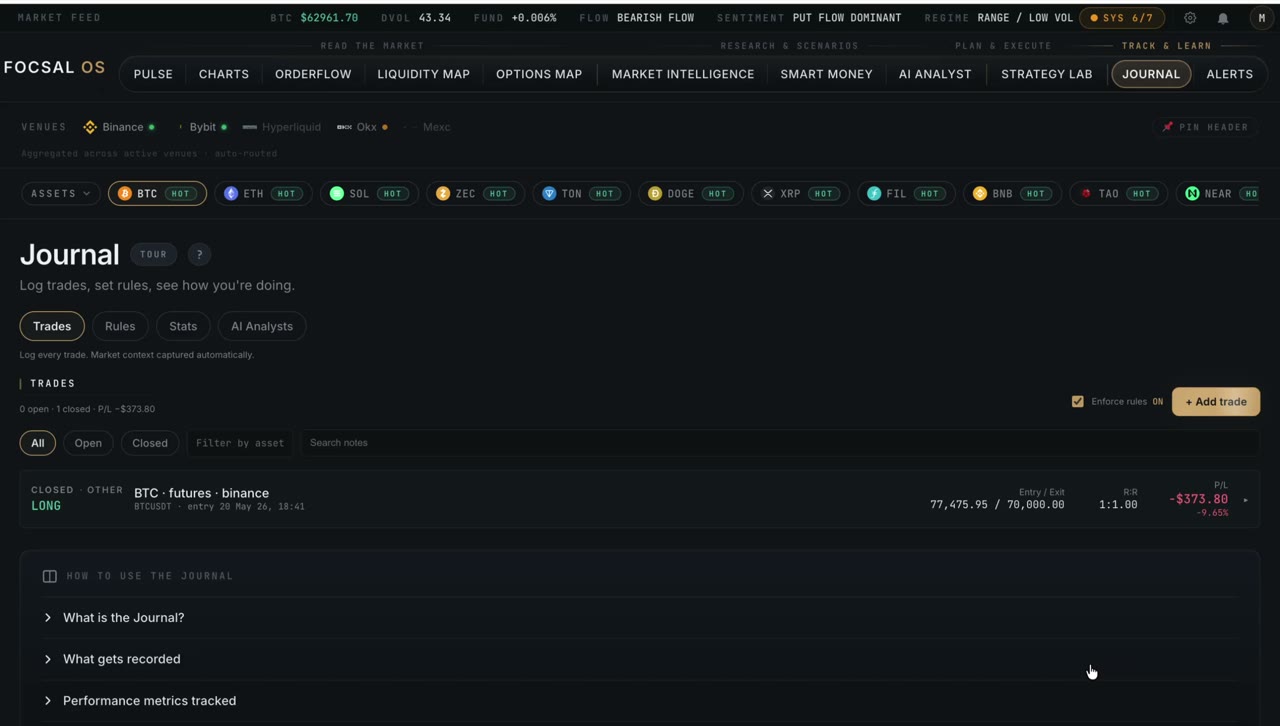
A trade journal that closes the loop. It logs your trades, computes your real performance, detects your behavioural patterns — and captures the market context at entry automatically, so you can finally answer which setups make you money.
Why it exists
Most traders journal in a spreadsheet or a standalone tool, copy-pasting entry, exit and a vague note. The problem is that none of it captures why you took the trade — what the market actually looked like at entry — so you can never properly answer the question that matters: which conditions make you money, and which quietly bleed your account.
Journal fixes that by living inside the platform. When you open a trade from the planner, the market context at that moment is captured with it — so later you can slice your performance by what the system was actually saying when you entered.
What you get
The four tabs
| Tab | What it gives you |
|---|---|
| Trades | A full log — date, asset, side, entry, exit, size, P&L, realized R:R and tags, with filters, inline edit and CSV export |
| Performance | Win rate, profit factor, average R:R, max drawdown, Sharpe, expectancy, an equity curve, and breakdowns by asset, tag, hour and day |
| Insights | Auto-detected patterns in plain language — loss aversion, revenge trading, overtrading windows, your strongest timeframe |
| Rules | Your own discipline rules, with violations flagged in Performance and their P&L cost quantified |
The Insights tab surfaces behaviour you'd never spot in a spreadsheet: "you hold winners too short," "you revenge trade after losses," "your discipline degrades after 5pm," "you're overtrading on Mondays." Naming the pattern is the first step to fixing it.
Closed-loop learning
Because the market context is captured at entry, the Performance tab can answer questions a standalone journal simply can't — like how your trades perform when the verdict was strong versus merely leaning, versus neutral. That turns journaling from record-keeping into a feedback loop: you discover that your high-conviction setups win far more often, and you adjust what you take. Rule violations are flagged too, with the actual P&L they cost you, so discipline becomes measurable rather than aspirational.
Journal is the "learn" end of the loop. Trades planned in Strategy Lab carry their context in; the Market Intelligence verdict at entry is captured automatically; and over time the Insights tab tells you which signals to trust — feeding back into how you set up Alerts. Find, plan, review, improve — a closed system.
Common questions
What is the FOCSAL Journal?
Journal is an integrated crypto trade journal with four tabs — Trades, Performance, Insights and Rules. It logs trades, computes performance metrics like win rate, profit factor, expectancy and drawdown, detects behavioural patterns, and tracks discipline rules, all inside the platform.
What is MI context auto-capture?
When you open a trade from the planner, the market verdict and context at that moment are captured automatically with the trade record. This lets the Performance tab break down results by what the system was saying at entry — for example, how trades perform on strong-conviction versus leaning versus neutral verdicts.
What behavioural patterns does the Journal detect?
The Insights tab automatically surfaces patterns such as holding winners too short, revenge trading after losses, overtrading on certain days, discipline degrading at certain hours, and which timeframe performs best for you.
Open Journal
Track trades, see your real performance and catch your patterns — included from the Plus plan upward.
See plans


